Video is searchable now.
A clip that has been read answers a search the way a photograph does. The words land on a single second of footage, and the player opens already sitting on that frame. What used to be one entry in the library turns into a few hundred findable moments inside it.
A reading covers what is on screen and what is audible over it — people, clothing, objects, settings, and alongside them the dialogue, the lyrics, the music and the sound of the room, each one fixed to the instant it happens. It works on whatever you bring in: footage you shot, a testimonial a client sent over, a clip you generated here.
Clips are read one at a time, on request. Three settings decide how finely — a slow product turn needs less than a fast cut — and the work carries on in the background whether or not you stay on the page.
Finding a moment
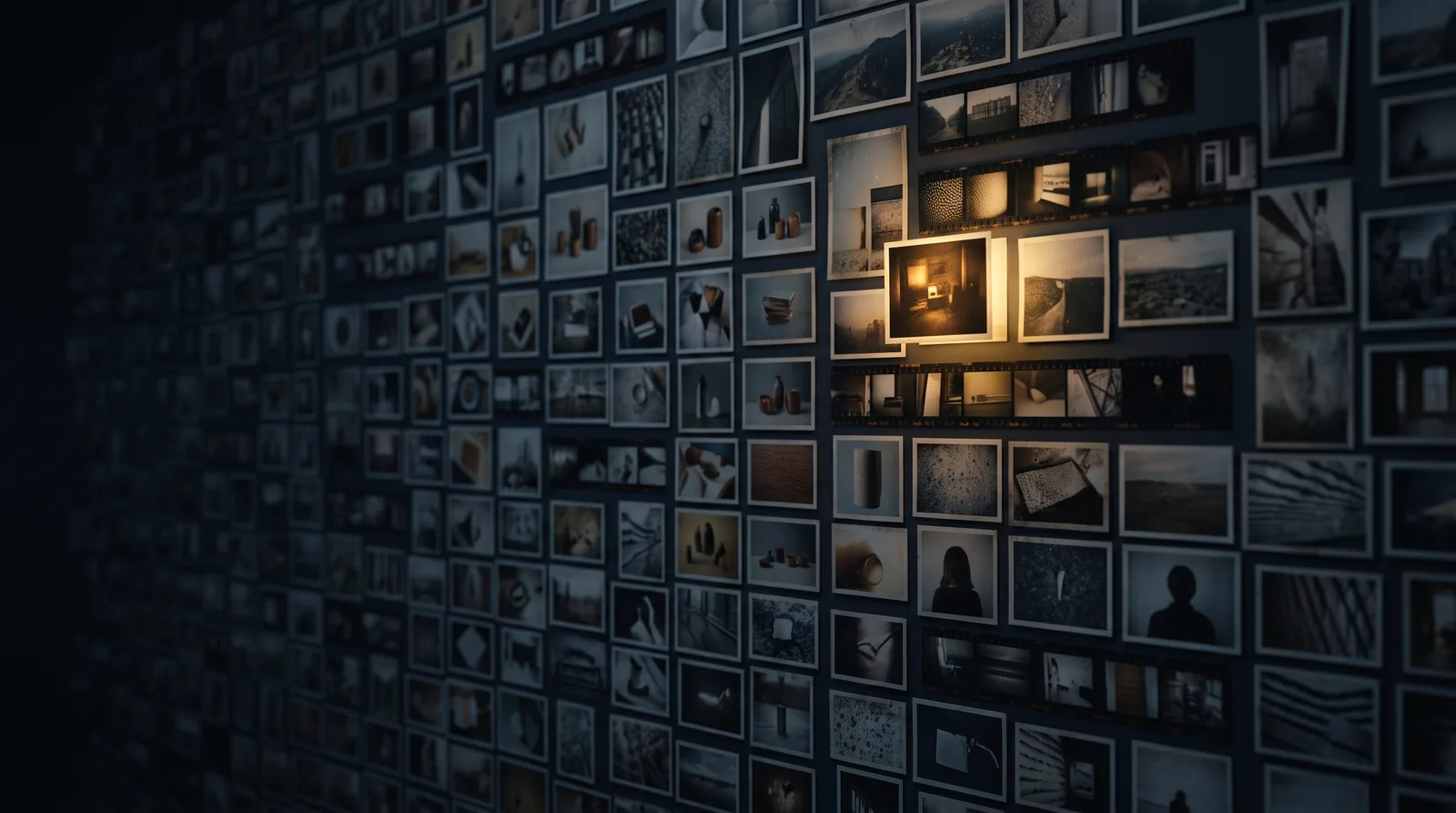
In ordinary search a clip sits among the photographs, saying how many of its moments matched and playing a short strip of its own footage. Opening it goes to the instant that matched rather than to the beginning.
Inside a single clip the same search fills the page with every frame that matched, ranked. The words reach both what was seen and what was heard: a jacket in shot, a line spoken over it, the description of the music underneath. Frames found by ear are marked as such, since a frame found by sound looks like nothing on its own. Colour works alongside the words rather than against them — ask for red and the reddest frames come forward, drawn from the clip's own palette rather than a generic wheel.
Speech and lyrics stay in the language they were spoken or sung in, written the way that language is written, so a line of Chinese dialogue is searchable in Chinese.
Looking at a clip
A reading produces more than an index, and the page gives it a few forms. Beside the player runs a written account that moves with the footage: what is in frame, what changes, what is being said, and what can be heard underneath. It follows the playhead on its own. A panel alongside holds everything the reading found — the cast first, then the rest grouped by kind, each row showing the detection cropped out of its own frame and opening into every frame it appears in.
On a wide shot, where a detection occupies forty pixels of the player, the mosaic puts six live close-ups beside the clip, each cut from the frame currently playing and moving with it.
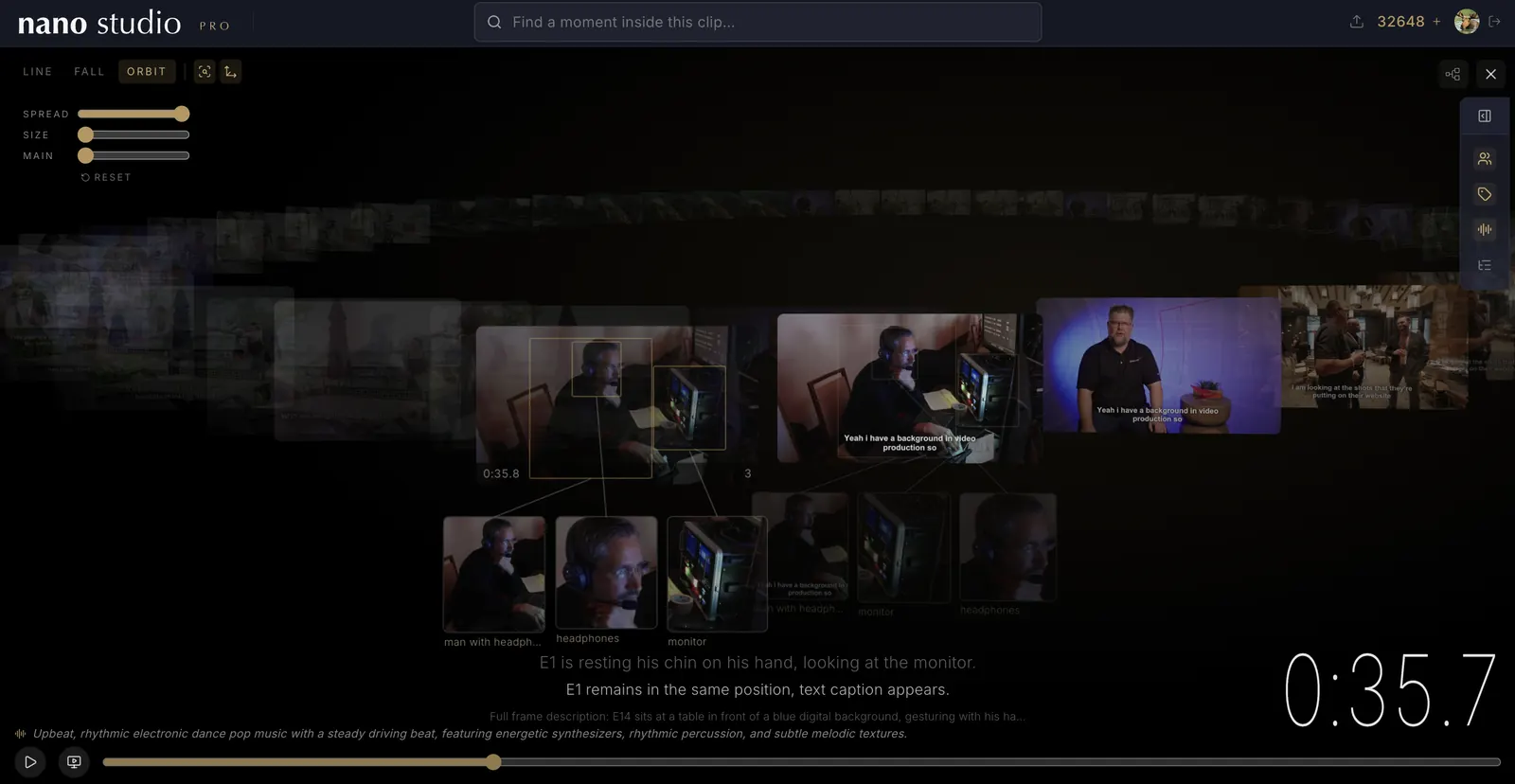
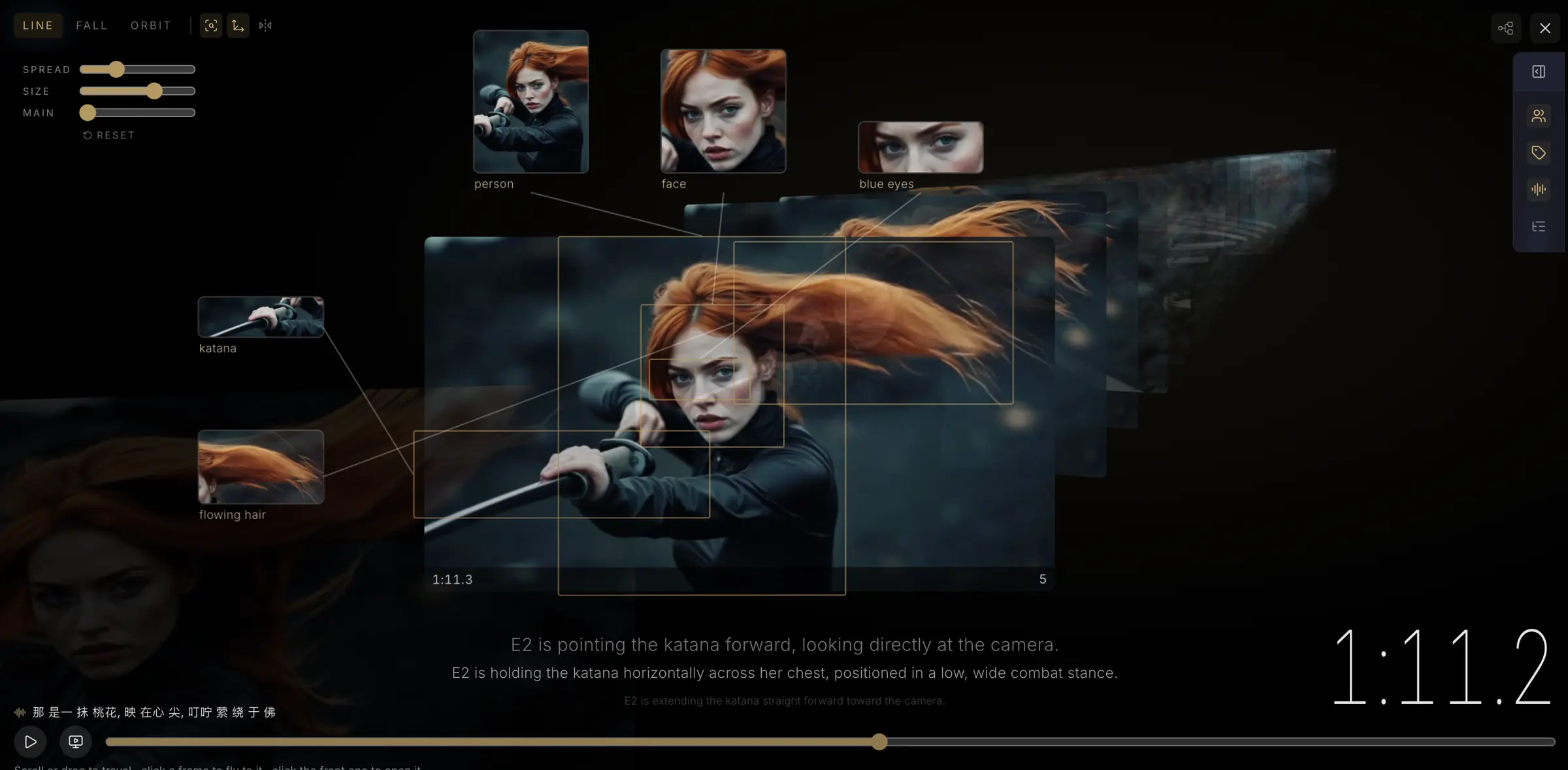
Then there is the corridor, which stands every frame of the clip in depth along its own timeline. You travel it by scrolling, and a frame flown to comes forward and opens into the player. Each detection on the frame at the front carries a labelled close-up joined back to its box, and the narration and the soundtrack run underneath as you go.
Searching from inside it lights the matches where they sit in time, the rest of the clip still standing around them, dimmed. That is enough to see at a glance whether the thing you asked for happens once at the end or all the way through.
The clip as a graph
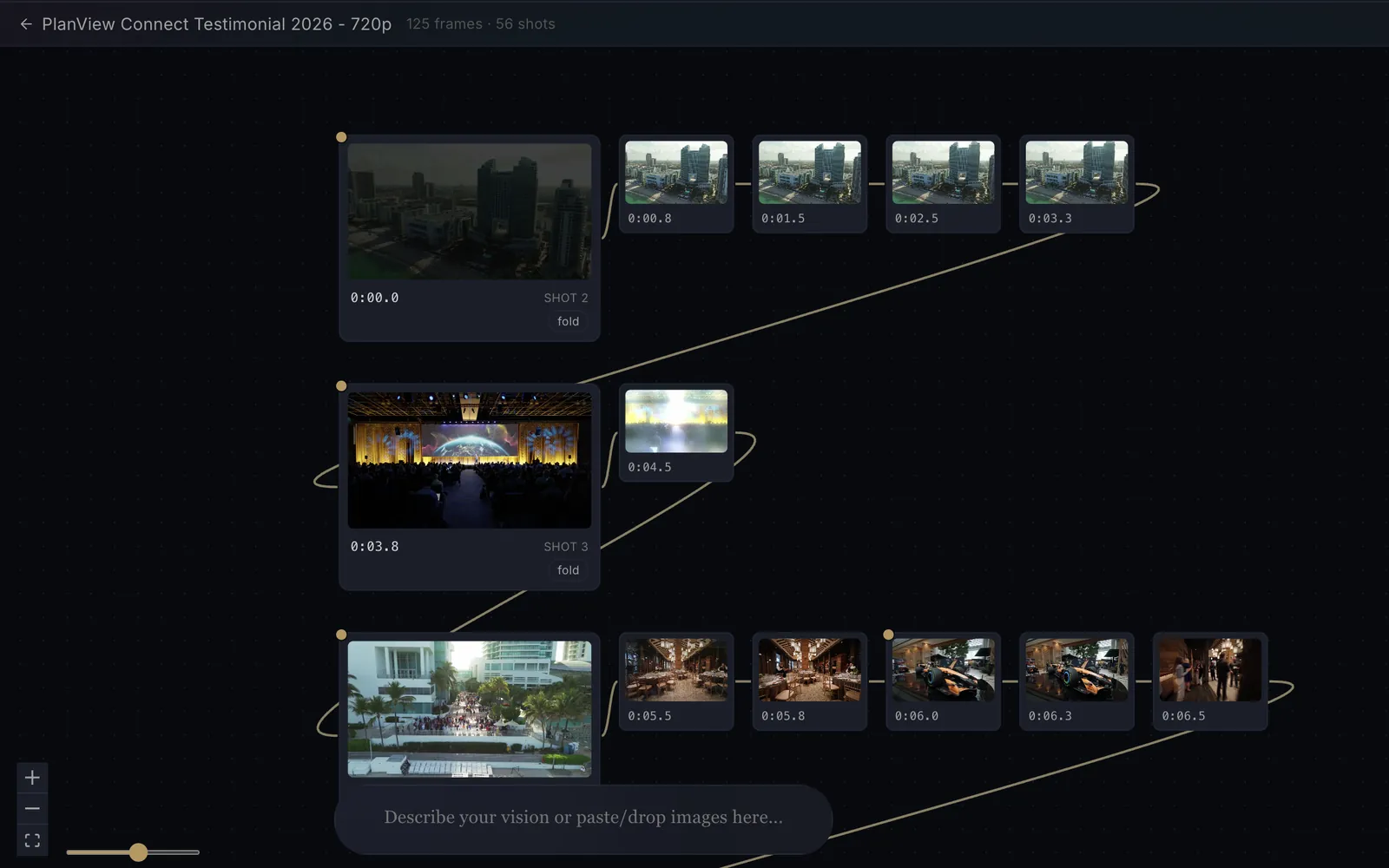
The same reading opens as a storyboard. Every shot becomes a row with its frames strung out beside it, folding down the canvas in order, so a whole clip is legible as structure rather than as a strip.
A short span can be unfolded into its true frames, at the footage's own rate rather than the reading's. A span can also be branched: the chosen frames appear again on a lane underneath, where they take a grade of their own, and a toggle beside the player runs that version against the original without anything being written to the file.
Names, and corrections
A person or an object holds together across cuts as one thing. Naming it links it to the same character your photographs use, which makes someone one person across the whole library; the description written during the reading stays where it is, with the name beside it.
Where a reading gets something wrong, the boxes give way. They can be drawn, moved, resized, renamed and deleted on any frame, and carried onto another frame in the strip — copied or moved, with the frames in between picking it up on the way. Anything added or renamed is searchable straight away.
A reading costs three credits a frame, the same rate as scanning a photograph, with the ceiling shown before it begins and the real figure — always lower — charged after. A run that fails costs nothing. Clips run to three minutes and uploads to 50 MB for now, one reading each, and nothing sweeps the library on its own.